I want you to try something.
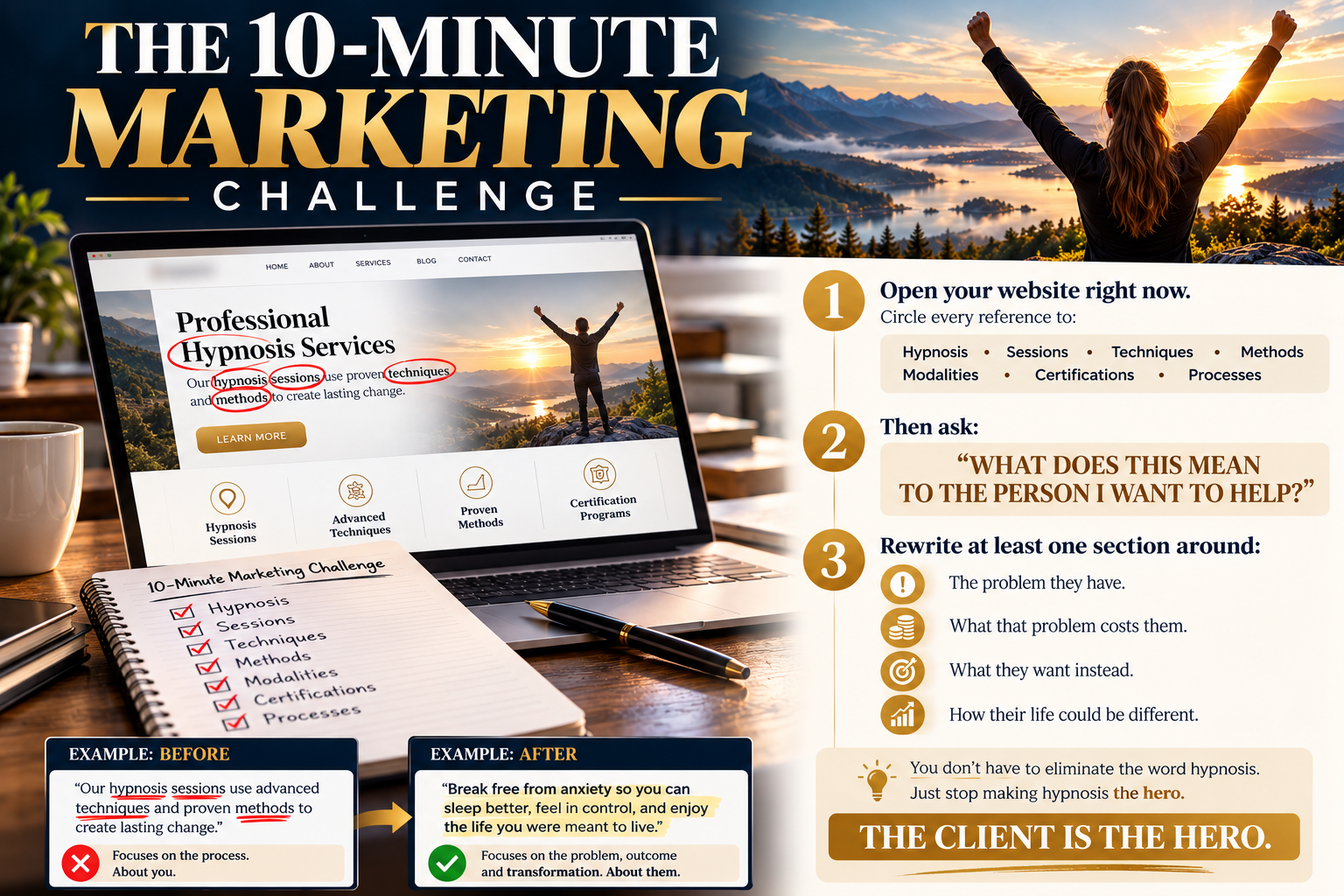
Go to your website.
Look at your homepage.
Look at your social media.
Look at your brochure.
Now pretend you’ve never studied hypnosis.
Pretend you don’t care about inductions, trance, the subconscious mind, regression, NLP, suggestion, or whatever methodology you use.
Ask yourself one question:
WHY SHOULD I CARE?
That’s the question your potential client is asking.
And too many hypnotists never answer it.
We spend so much time learning hypnosis that we naturally become fascinated with the process.
Our clients usually aren’t.
They care about what they believe the process might do for them.
That distinction changes everything.
Think about it.
Almost nobody wakes up Monday morning thinking:
“You know what I really want today? A great hypnotic induction.”
They wake up thinking:
“I’ve got to stop smoking.”
“I can’t keep feeling like this.”
“I need to get my confidence back.”
“I have to perform better.”
“I need to get control of this habit.”
“I can’t keep freezing every time I have to speak.”
“I want my life to change.”
Then they start looking for a way to accomplish that.
Hypnosis may be the vehicle.
But hypnosis isn’t necessarily what they’re buying.
People don't buy hypnosis. They buy what they believe hypnosis will allow them to feel, do, become, experience, or leave behind.
Understand that and your marketing changes immediately.
This isn’t unique to hypnosis.
People rarely buy products entirely for the physical product itself.
A luxury watch tells time.
So does a $20 watch.
But the person spending thousands of dollars probably isn’t buying better access to the current hour.
They’re buying something else.
Status
Achievement
Identity
Recognition
Belonging
A parent buying a toy isn’t always buying plastic.
Sometimes they’re buying:
Thirty minutes of peace.
Someone joining a gym isn’t buying access to exercise equipment.
They may be buying:
Confidence. Attraction. Energy. Identity. Pride.
People buy the thing.
But underneath the thing is usually something more important:
Hypnosis is no exception.
.
Let’s make this practical.
You might think you’re selling:
A smoking cessation hypnosis program.
The client may actually be buying:
Freedom
Freedom from thinking about cigarettes.
Freedom from smelling like smoke.
Freedom from standing outside.
Freedom from worrying about what smoking is doing to them.
Freedom from feeling controlled by something they wish they could leave behind.
You’re not necessarily selling:
Hypnosis for public speaking.
The client may be buying:
Confidence.
The ability to walk onto a stage without that familiar dread.
To raise their hand in a meeting.
To deliver the presentation.
To speak without feeling like everyone is judging them.
You’re not selling:
Sports hypnosis
The athlete may be buying:
Performance
The ability to access their training when the pressure is highest.
To stop getting in their own way.
To perform in competition the way they know they can perform in practice.
A hypnosis session for fear
The person may be buying:
Getting on the airplane.
Driving across the bridge.
Walking into the room.
Doing the thing they’ve spent years avoiding.
Confidence hypnosis
You’re potentially selling:
What confidence allows someone to do …
Ask for the promotion.
Go on the date.
Start the business.
Walk onto the stage.
Make the call.
Say no.
Say yes.
Be seen.
Here’s one of the simplest marketing exercises I know.
Take whatever you’re currently selling and ask:
“I’m offering a six-session hypnosis program.”
So what?
“It uses several powerful hypnotic techniques.”
“It helps the person change their internal patterns.”
“They can respond differently in situations that used to trigger the old behavior.”
“They can finally feel in control.”
There it is
That’s much closer to what you’re actually selling.
Keep asking “So what?” until you reach something the customer emotionally cares about.
Here’s the framework I want you to remember.
What is it?
It’s FINE. But that’s just the feature.
What does that feature help them accomplish?
BETTER
How do they want to feel?
Confident
Free
Safe
In control
Proud
Wanted
Capable
Now we’re getting SOMEWHERE …
Who do they believe they can become?
This is the deepest level.
NOT:
“I completed six hypnosis sessions.”
BUT:
“I’m finally someone who can get on an airplane without spending the entire week terrified.”
or
“I’m someone who can walk into that meeting and speak.”
“Cigarettes aren’t controlling my day anymore.”
Features explain what you're selling. Transformation explains why someone should want it.
This is where practitioners get themselves into trouble.
We use words that mean something to us.
Induction.
Deepener.
Regression.
Submodalities.
Anchoring.
Suggestion.
Trance depth.
Parts work.
Ideomotor response.
Those may all be useful concepts.
But your client doesn’t necessarily care.
Worse, sometimes our language forces the client to learn our profession before they can understand why they should hire us.
That’s backwards.
You should be able to explain the value of your work to someone who knows absolutely nothing about hypnosis.
If your marketing requires the prospect to understand your methodology before they can understand the benefit—
You’re Making Them Work Too Hard.
There’s an important distinction here.
Selling the desired outcome doesn’t mean guaranteeing an outcome you cannot guarantee.
Don’t tell someone:
“I will eliminate your fear permanently.”
Don’t manufacture certainty where none exists.
Don’t make medical or psychological claims beyond your competence or evidence.
Good marketing doesn’t require dishonesty.
You can talk about what the client wants without promising that every person will achieve it.
For example:
Instead of:
“I guarantee you’ll become completely confident.”
Try:
“Our work is designed to help you develop greater confidence when it matters most.”
The goal is not hype.
The goal is relevance.
Speak to the result the person cares about while remaining truthful about what you’re offering.
There’s another mistake I see constantly.
The practitioner becomes the entire advertisement.
My certification.
My method.
My training.
My technique.
My years of experience.
Those things matter.
They build credibility.
But they’re supporting evidence.
They’re not the story.
Your potential client is sitting there thinking:
What happens to me?
Can you understand my problem?
Have you worked with people like me?
What could change?
Why should I trust you?
What happens next?
Your credentials help answer:
But don’t mistake that for:
The future belongs to lifelong students. Not perpetual certificate collectors. There's a difference.
The next time you’re creating an offer, website, advertisement, social post, consultation, or presentation, don’t start with:
Start with:
That’s the conversation they’re already having in their head.
Meet them there.
Then explain how hypnosis may help them move toward it.
Because your client doesn’t need to fall in love with hypnosis.
They need to believe there’s a credible path between:
WHERE I AM NOW
and
WHERE I WANT TO BE.
Hypnosis is the vehicle you’re offering to help them travel that distance.
You can have the greatest technique in the world.
You can have twenty certifications.
You can understand hypnosis at a level your competitors don’t.
But if the person who needs your help can’t understand why any of that matters to them, they’re probably not going to buy.
So stop leading with the process.
Start with the person.
Stop leading with the technique.
Start with the problem.
Stop leading with what hypnosis is.
Start with what could become possible.
Your clients aren't buying the process. They're buying the possibility of becoming someone who no longer has the same problem.
HYPNOSIS WORLD MAGAZINE
Founding Issue #001 • September 1, 2026
The World of Hypnosis. Delivered Every Tuesday.